



For small and mid-sized businesses, a missed phone call can mean more than an unanswered inquiry. It can mean a customer choosing a competitor before the business has a chance to respond. New research from Upfirst suggests this problem is becoming one of the strongest drivers behind the adoption of artificial intelligence in business communications.
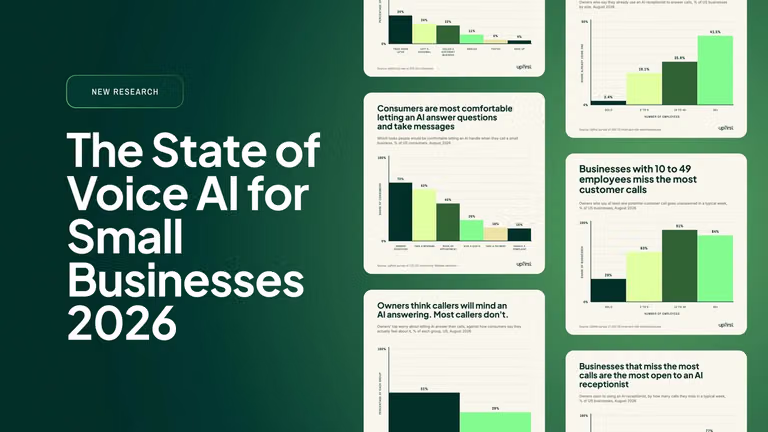
According to The State of Voice AI for Small Businesses 2026, 91% of US businesses with 10 to 49 employees miss at least one potential-customer call during a typical week. Within that same group, 79% say they have already lost a customer because of an unanswered call.
The findings point to an operational gap that traditional hiring has not necessarily solved. Smaller companies often receive more calls than their owners can handle, but lack the resources or call volume to justify maintaining a full-time receptionist.
Across all businesses surveyed, 58% reported missing at least one potential-customer call in a typical week. Meanwhile, 78% of consumers said they had hired or purchased from a competitor at some point because a business failed to answer or return their call.
AI is expanding customer service capacity, not replacing receptionists
The consumer response also suggests that businesses have limited opportunities to recover those interactions. When a local business does not answer, only 24% of callers leave a voicemail, while 22% immediately contact another provider.
One of the report’s more notable findings challenges the assumption that businesses primarily adopt AI receptionists to reduce their workforce.
Only 2.4% of solo operators reported using an AI receptionist, compared with 41.5% of businesses with 50 or more employees. Adoption increases alongside company size, suggesting that the technology is finding demand among organizations already managing substantial phone workloads.
The operational data reinforces this pattern. Among businesses using AI receptionists, 79% still have employees covering calls outside regular business hours. Furthermore, 16.4% of the calls analyzed included an attempt to transfer the caller to a human.
The findings suggest that voice AI is increasingly being deployed as an additional layer of customer service, handling interactions that existing staff cannot reach rather than eliminating the need for human employees.
This distinction could shape how businesses evaluate the technology, particularly as the cost of running voice agents continues to fall.
Language support creates another opportunity for voice AI
The report also identifies language accessibility as a business problem. Some 29% of surveyed owners said a language barrier during a phone conversation had already cost them a customer.
Upfirst’s analysis of 677,562 calls handled for 2,967 US businesses between January 2025 and August 2026 found that 13.4% of all calls were conducted in Spanish. Among 1,102 businesses using an Upfirst receptionist with at least 50 calls, 90% received at least one Spanish-language call.
For businesses that cannot justify hiring bilingual receptionists to handle occasional demand, AI-powered systems offer another way to manage those interactions.
Consumer trust depends on transparency
Despite growing adoption, customer acceptance remains an important consideration. Upfirst found that 43% of consumers were comfortable with a small business using an AI receptionist, while 29% were uncomfortable and the remainder were neutral.
However, the report identifies a specific condition for building trust: transparency.
Four in five consumers said they wanted an AI receptionist to identify itself as artificial intelligence at the beginning of a call. Among consumers skeptical of the technology, disclosure was the most important trust factor, ranking ahead of how human the voice sounded.
Consumers were also more receptive to specific tasks. Some 70% were comfortable with AI answering questions about business hours, services and pricing, while 62% accepted having an AI take a message. Acceptance fell to 16% for payment processing and 15% for handling complaints.
The research, based on surveys of 270 US consumers and 262 small and mid-sized business owners, alongside real-world call data, offers a snapshot of how voice AI is entering everyday business operations. Its survey panels were opt-in rather than probability-based, meaning the findings should not be interpreted as nationally representative.
For the voice AI market, the findings highlight an opportunity built around a relatively straightforward business problem: keeping customers from going elsewhere simply because nobody picked up the phone.